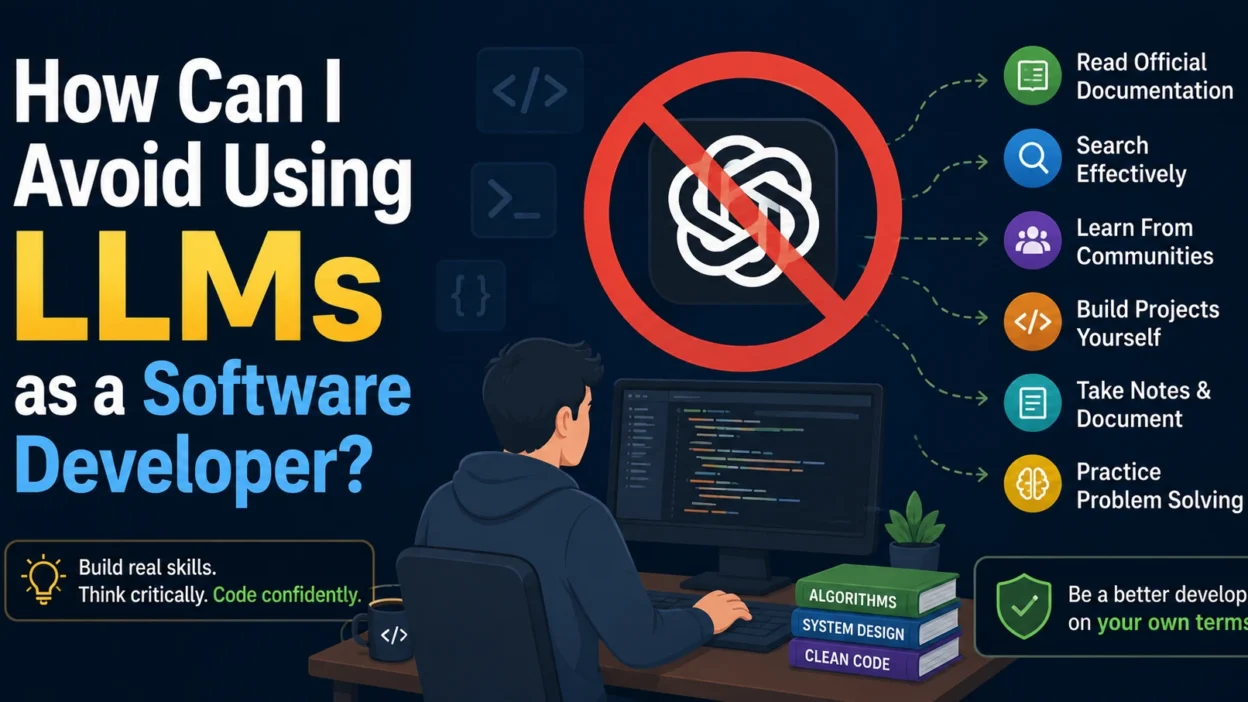
Large Language Models (LLMs) such as ChatGPT, Claude, Gemini, and Copilot have become common tools in software development. They can generate code, explain concepts, and help debug issues. However, some developers prefer not to rely on LLMs for coding due to privacy concerns, learning goals, accuracy issues, or personal preference.
If you’re wondering how to avoid using LLMs as a software developer, this guide explores practical alternatives and workflows.
Why Avoid LLMs?
Developers choose to avoid LLMs for various reasons:
- Want to improve problem-solving skills
- Privacy and security concerns
- Avoid AI-generated bugs
- Build deeper understanding of code
- Company policies restricting AI tools
- Preference for traditional development methods
Avoiding LLMs doesn’t mean becoming less productive—it simply means relying on other resources and techniques.
1. Read Official Documentation
The most reliable source of information is usually the official documentation.
Examples:
- Python Documentation
- Java Documentation
- PHP Documentation
- Linux Man Pages
- Framework Documentation
Instead of asking an AI:
How do I read a file in Python?
Search the official docs and examples.
Benefits:
- Accurate information
- Latest features
- Better long-term understanding
2. Improve Debugging Skills
Many developers use AI primarily for debugging.
Instead, learn to use:
- Error messages
- Stack traces
- Logs
- Debuggers
For example:
print(variable)
or
import pdb
pdb.set_trace()
Strong debugging skills often reduce the need for AI assistance.
3. Use Search Engines Effectively
Search engines remain one of the most powerful developer tools.
Good search examples:
python read file example
bash find files recursively
react useeffect cleanup function
Learning effective search techniques can often solve problems faster than prompting an AI.
4. Learn From Community Forums
Programming communities contain millions of solved problems.
Popular sources include:
- Stack Overflow
- GitHub Discussions
- Reddit programming communities
- Language-specific forums
These resources often provide multiple solutions and explanations from experienced developers.
5. Build Small Projects Without AI
A practical way to reduce AI dependence is to intentionally build projects without using AI tools.
Examples:
- Calculator app
- To-do application
- Weather dashboard
- Blog website
- File organizer script
This strengthens:
- Research skills
- Architecture decisions
- Problem-solving abilities
6. Read Other People’s Code
Open-source projects are valuable learning resources.
Study:
- Project structure
- Design patterns
- Coding styles
- Testing approaches
Reading quality code often teaches more than generated code snippets.
7. Keep Personal Notes
Create your own knowledge base.
Tools:
- Obsidian
- Notion
- Markdown files
- Personal wiki
Document:
- Commands
- Fixes
- Code snippets
- Best practices
Over time you’ll need fewer external resources.
8. Use Books and Courses
Before AI became popular, developers learned through:
- Books
- Documentation
- Video courses
- Tutorials
These resources are still extremely valuable because they teach concepts systematically.
Examples:
- Clean Code
- The Pragmatic Programmer
- Designing Data-Intensive Applications
9. Practice Problem Solving
Instead of asking AI for solutions immediately:
- Define the problem.
- Break it into smaller parts.
- Research each part.
- Attempt a solution.
- Review and improve.
This process develops long-term engineering skills.
10. Use AI Only as a Last Resort
Some developers choose a balanced approach:
- Try solving the issue yourself first.
- Read documentation.
- Search existing solutions.
- Ask colleagues.
- Use AI only if stuck.
This reduces dependency while still benefiting from modern tools when needed.
Common Benefits of Avoiding LLM Dependence
Developers who rely less on AI often improve:
- Debugging ability
- System design thinking
- Documentation reading skills
- Research skills
- Code comprehension
- Technical confidence
The goal isn’t necessarily to eliminate AI completely but to ensure your skills remain strong without it.
Conclusion
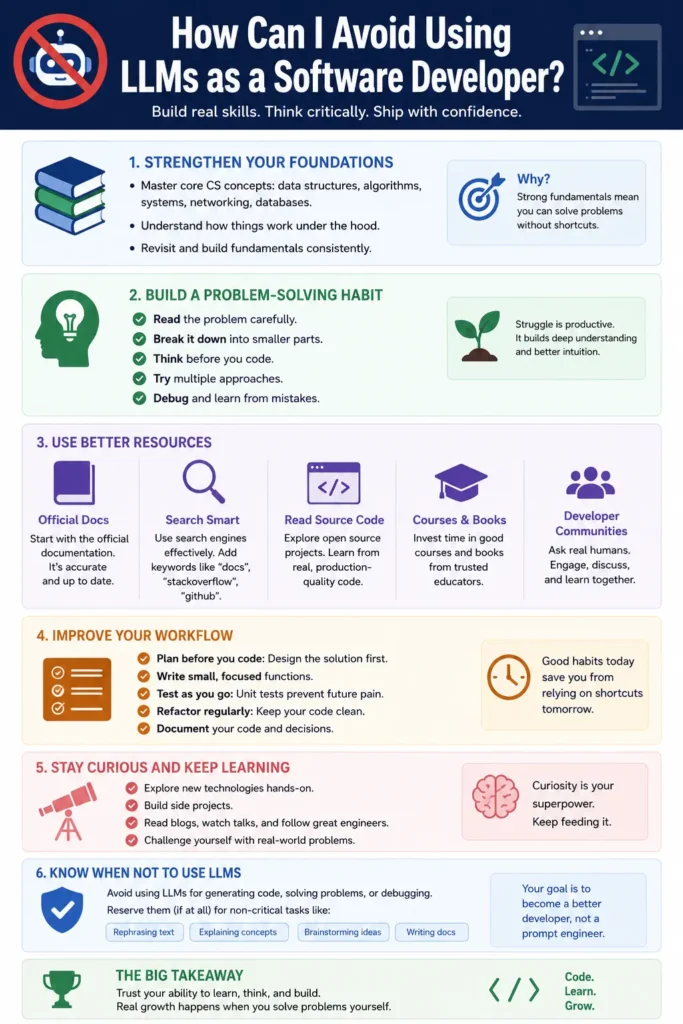
You can absolutely be a successful software developer without relying on LLMs. By focusing on documentation, debugging, search skills, open-source code, books, and hands-on practice, you’ll build a deeper understanding of software development fundamentals.
LLMs can be useful tools, but they are not a requirement for becoming a great developer. Strong engineering skills come from understanding problems, experimenting with solutions, and continuously learning through experience.
Happy Coding!